The math: everything comes down to one inequality
Most business owners treat lead generation like weather. Some months it’s raining clients, some months it’s a drought, and nobody knows why.
Here’s the truth: leads are not weather. Leads are math.
Once you understand the math, acquisition becomes as predictable as this: want $10,000 in revenue? Spend $1,000–4,000 on acquisition. Want $100,000? Spend $10,000–40,000. Want $1,000,000? Spend $100,000–400,000.
This article teaches you the whole system, step by step, assuming you’re starting from zero: the math (the one inequality that runs your entire business), the channels (where to put the money, and how to split it), and the user journey (what happens between the first click and the signature). Let’s build the machine.
The only equation that matters
The entire game of customer acquisition comes down to this: CAC < LTV. Two acronyms. Let’s define them like you’ve never heard them before.
CAC, Customer Acquisition Cost. How much it costs you to acquire ONE customer. All of it: ads, tools, sales time, commissions. If you spent $3,000 last month and signed 3 clients, your CAC is $1,000.
LTV, Lifetime Value. What one client brings you over their entire lifespan with you. Not the first invoice, ALL the invoices.
If your CAC is lower than your LTV, every client you buy makes you money. You’ve built a machine where you insert $1 and it returns $3, $5, $10. At that point, the question is no longer “should I spend on acquisition?” it’s “how fast can I feed the machine?”
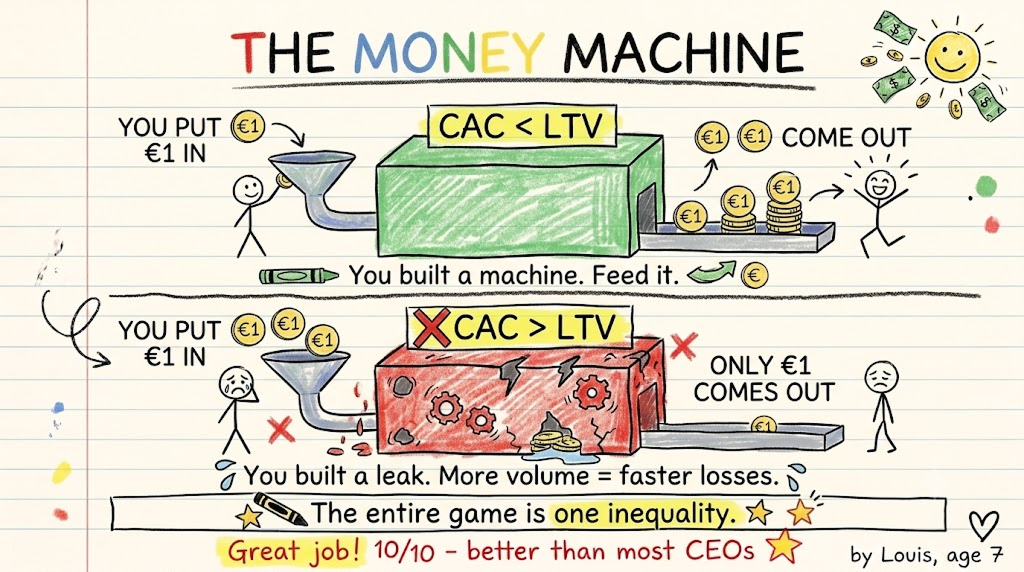
If your CAC is higher than your LTV, every client you acquire loses you money. No amount of hustle, branding, or motivation fixes that. It’s a leak, and more volume just means losing money faster.
The CAC most people calculate is a lie
Quick warning before you run your numbers. Most business owners calculate CAC like this: ad spend ÷ new clients. That’s not your CAC. That’s a fraction of it.
Your real CAC the “fully loaded” CAC includes everything it takes to turn a stranger into a signed contract:
- Ad spend (the obvious part)
- Sales salaries, prorated on time spent selling (if your sales rep costs $5,000/month and spends 50% of their time on new business, that’s $2,500/month of CAC)
- Tools: CRM, dialer, email sequencer, data provider
- Commissions and bonuses on new deals
- Content and creative production tied to acquisition
Run the numbers both ways and you’ll typically find your real CAC is 30–50% higher than your “ad spend only” CAC. That’s not a detail. If your ceiling is $2,700 and your fake CAC says $2,000, you might actually be at $2,900 losing money on every client while your dashboard shows green.
Rule: if the cost disappears when you stop acquiring clients, it’s CAC. If it stays, it’s not.
Calculate YOUR two numbers (real example)
Let’s use a real business. You sell B2B office cleaning at $1,500/month. Your clients stay 6 months on average. LTV = 6 × $1,500 = $9,000 per contract.
Now, how much can you spend to win one of those contracts? The healthy rule of thumb in B2B: your CAC should sit between 10% and 30% of your LTV. Your acceptable CAC = $900 to $2,700 per client.
You can spend up to $2,700 to sign ONE cleaning contract and remain highly profitable. Most of your competitors would panic at spending $500 because they never did this calculation.
Turn your revenue goal into a budget
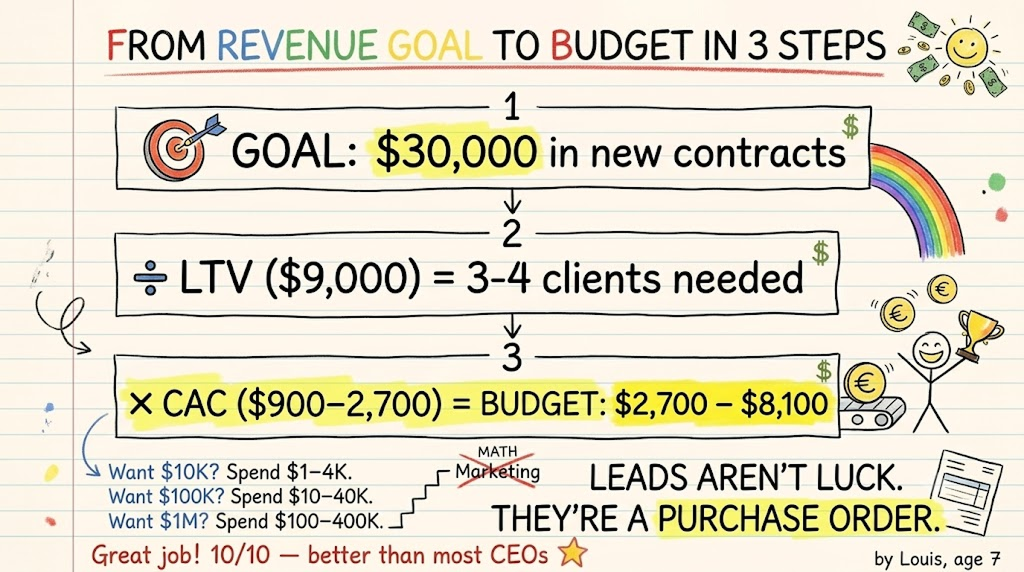
Now flip the equation. This is where “predictable leads” comes from. You want $30,000 in new contracts this quarter?
$30,000 ÷ $9,000 LTV = you need ~3-4 new clients. 3 clients × ($900 to $2,700 CAC) = budget $2,700 to $8,100 for acquisition. That’s it. That’s the whole trick.
Revenue goal → number of clients → acquisition budget. You’ve just turned “I hope we get leads this quarter” into a purchase order.
The mindset shift
Here’s what changes when you know these two numbers: the problem is never “ads are expensive.” $2,700 for a $9,000 contract isn’t expensive it’s a 233% return. The problem is not knowing your numbers.
When you don’t know your CAC and LTV, every dollar spent feels like a risk. When you know them, every dollar spent is an investment with a known return.
If you don’t know your CAC and your LTV, you’re not running a business. Okay. You know your numbers. You have a budget. Now: where does the money actually go?
The third number: payback period
CAC and LTV tell you IF you make money. They don’t tell you WHEN. That’s the payback period: how many months before a client has reimbursed their own acquisition cost.
Back to the cleaning company. CAC = $2,700, client pays $1,500/month. Payback = 2,700 ÷ 1,500 = 1.8 months. After month two, everything that client pays is profit on the acquisition.
Now imagine a SaaS charging $200/month with the same $2,700 CAC. LTV might still be great (clients stay 3 years = $7,200 LTV, CAC/LTV ratio looks healthy). But payback = 2,700 ÷ 200 = 13.5 months. You’re fronting $2,700 per client and waiting over a year to get it back.
Why this matters: CAC/LTV decides if the machine is profitable. Payback decides if you can afford to run it. A profitable machine with a 13-month payback and 20 new clients a month means $54,000 of cash locked up at any time, growing as you scale. Plenty of “profitable” companies have died from this exact math.
Benchmarks: under 3 months is exceptional, scale aggressively. 3–6 months is healthy for most B2B services. 6–12 months is acceptable if you have cash reserves or funding. Over 12 months, you’re a bank giving loans to your own clients.
Practical consequence: two levers shorten payback without touching CAC. Charge upfront (annual prepay, setup fees) or front-load the contract (bigger first invoice). Every dollar collected earlier is a dollar you can reinvest in acquisition earlier which compounds.
The channels: where the money goes
There are only two families of channels
Every acquisition channel in the world Google, LinkedIn, cold email, SEO, events, all of them falls into one of two categories. Only two.
1) Demand capture channels. The prospect is already looking for your solution. They have the problem, they know it, they type it into Google. Your job: be there when they search. Google Ads (Search), SEO, directories and comparison sites, Google Maps / local listings.
2) Demand generation channels. The prospect isn’t looking for you. They may have the problem, but they’re not actively hunting for a solution. Your job: interrupt them intelligently and create the “aha” moment. Cold email / cold calling, LinkedIn Ads, Meta Ads, LinkedIn / YouTube content, events, webinars, partnerships.
Why this distinction changes everything: with demand capture, the prospect’s intent is hot they’re actively searching for a solution right now. Conversion rates are high, sales cycles are short, and the cost per lead is higher but every lead is qualified. The catch: the available volume is capped by search volume. You can’t capture more demand than exists.
With demand generation, intent is cold the prospect isn’t searching for anything. Conversion rates start low, sales cycles are long, and while the cost per lead is lower, each lead needs to be educated before buying. The upside: the volume is virtually unlimited, because you’re creating demand instead of waiting for it.
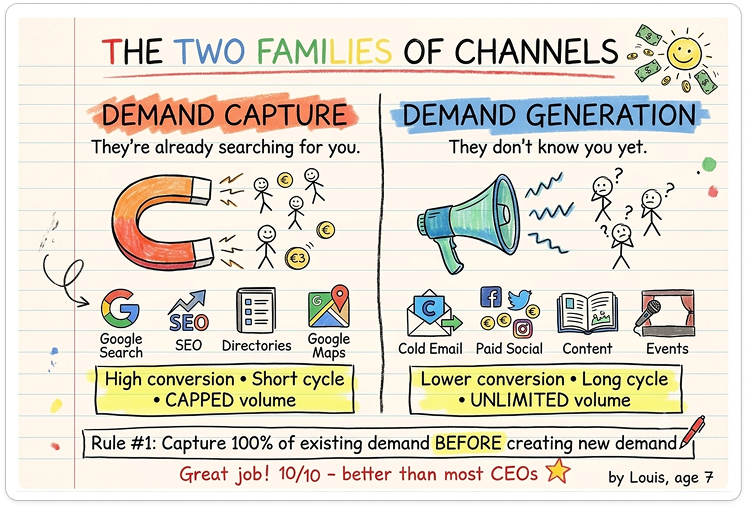
Remember the most important row: demand capture is capped. If 500 people per month search “office cleaning company Chicago,” you can never capture more than 500 searches. Even with an infinite budget. That’s why companies that scale all eventually move into demand generation they’ve exhausted existing demand.
The golden rule of allocation
The order, no exceptions: first, capture 100% of existing demand. This is the easiest money of your life. These prospects want to buy TODAY. Being absent from Google when someone searches for exactly your service is leaving cash on the sidewalk.
Only then, create demand. Once you’re capturing everything that already exists and you want more volume, you move to demand generation.
The classic mistake: an SMB launching Meta Ads (cold prospects, long cycle) when they don’t even have a Google Search campaign running (hot prospects, ready to buy). Cart before the horse and it burns budget fast.
The 70 / 20 / 10 split
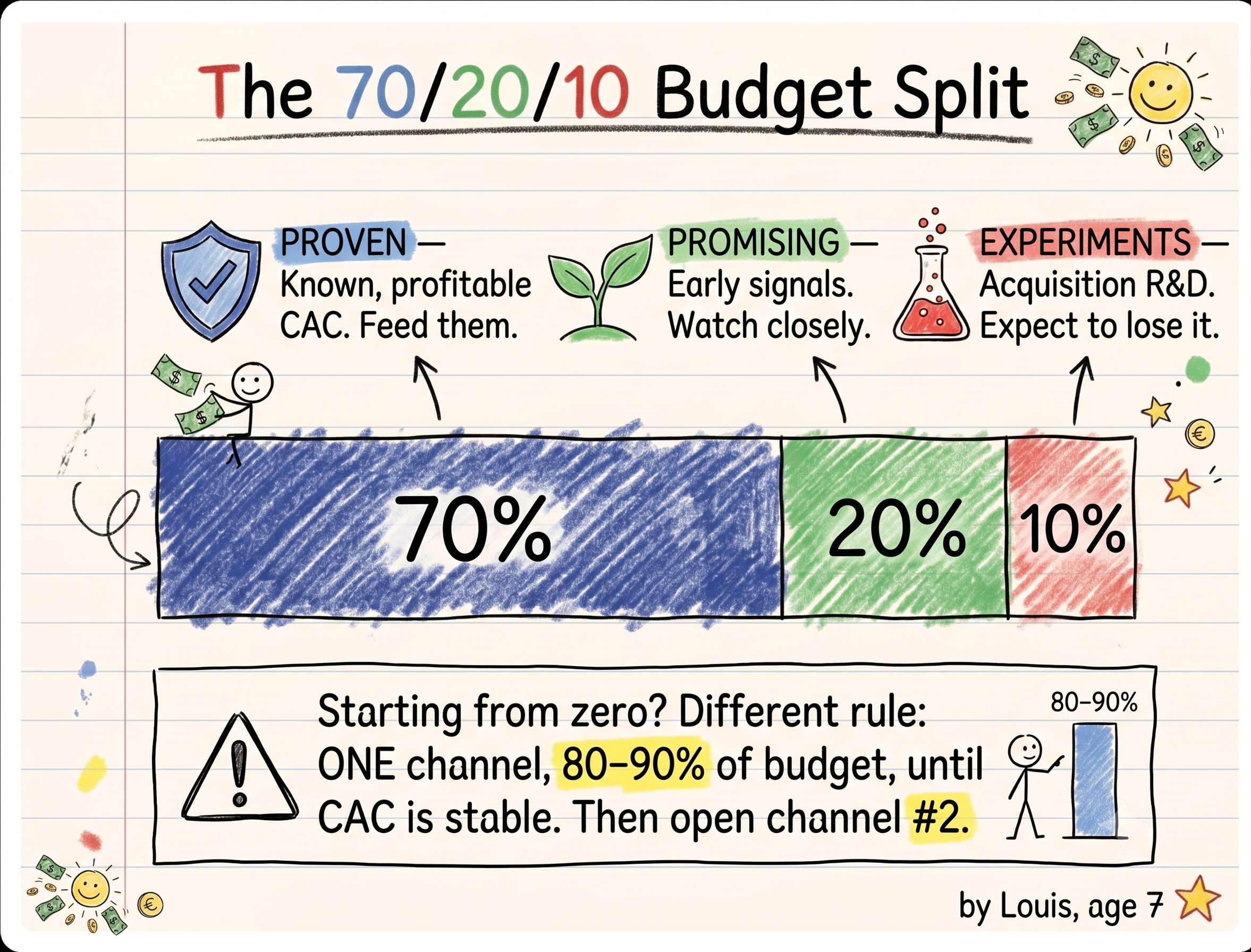
Once you have your budget from Part 1, here’s how to divide it: 70% on proven channels the ones where you know your CAC and it’s below your ceiling. Don’t touch, just feed. 20% on promising channels early signals, numbers not yet stable. 10% on experiments new channels, formats, messages. Your acquisition R&D budget. You accept losing it.
Special case just starting, no proven channel yet? The rule changes: ONE channel at a time. Pick the one closest to existing demand (usually Google Search or tightly targeted cold outreach), put 80–90% of the budget on it, iterate until the CAC is stable and profitable. Only then open channel #2.
Why? Because $1,000 spread across 3 channels gives you no usable data on any of them. $3,000 on one channel tells you within 60 days whether it works.
Calculate the CAC of each channel (full example)
Back to our cleaning company: LTV = $9,000, CAC ceiling = $2,700. Every channel has its own conversion chain. Let’s break down three.
Channel 1: Google Ads. Cost per click: $6. Landing page → lead: 5% → cost per lead = $120. Lead → meeting: 50% → cost per meeting = $240. Meeting → client: 25% → CAC = $960.
Channel 2: Cold email. Cost per contact (data + tools + time): $2. Positive reply rate: 2% → cost per lead = $100. Lead → meeting: 60% → cost per meeting = $167. Meeting → client: 15% (colder prospects) → CAC = $1,113.
Channel 3: LinkedIn Ads. Cost per click: $12. Page → lead: 3% → cost per lead = $400. Lead → meeting: 40% → cost per meeting = $1,000. Meeting → client: 20% → CAC = $5,000 way above the $2,700 ceiling.
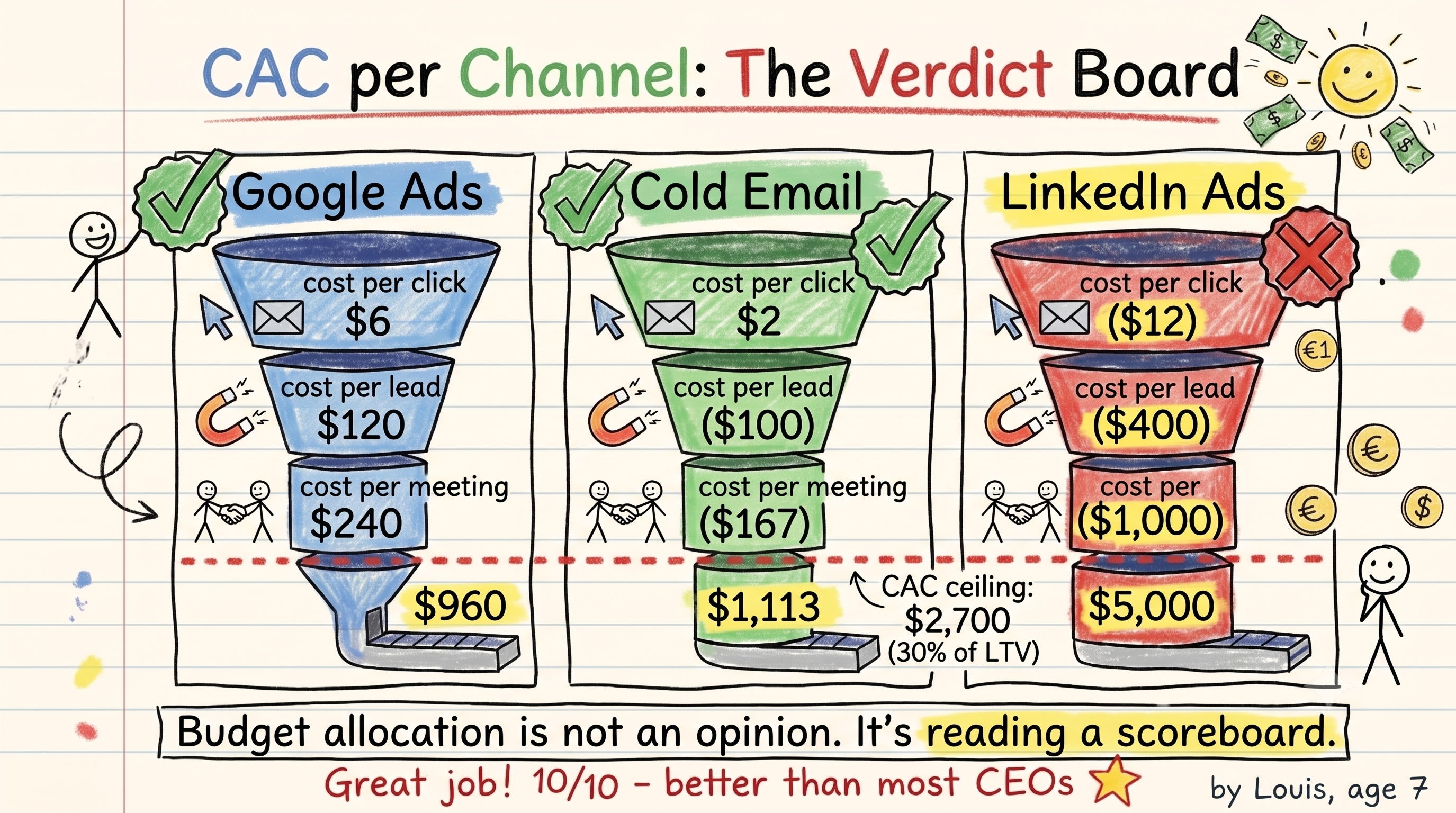
The conclusion writes itself: Google Ads and cold email are profitable, LinkedIn Ads isn’t (as it stands). Logical split for this company with an $8,000/month budget: Google Ads $5,600 (70%, best conversion), cold email $1,600 (20%, needs stabilizing), experiments (local SEO, partnerships) $800 (10%).
The tool stack behind the numbers
Those CAC calculations assume you actually have the machinery running. Here’s the minimum stack, layer by layer, with what each one does to your math.
Layer 1 Data (Apollo). Cold outbound starts with a list, and the list is where most campaigns die. A platform like Apollo lets you filter by industry, headcount, revenue, technology used, and job title, then export verified emails and direct dials. The math impact: bad data means 20–30% bounce rates, which burns your sender reputation and silently kills deliverability your cost per contact doubles without you seeing it. Budget $50–150/month. That’s the “$2 per contact” line item from the cold email breakdown.
Layer 2 Email sequencing (Lemlist). The sending layer decides whether your emails get seen at all. A tool like Lemlist handles inbox warm-up, sending limits per mailbox, personalization at scale, and most importantly automatic multi-step sequences. Here’s the number that matters: roughly half of positive replies in cold email come from follow-ups, not the first message. No sequencer = you send one email, get no reply, and conclude “cold email doesn’t work.” You paid full price for half the channel.
Layer 3 Calling (Paradialer). Same logic applies to cold calling. A rep dialing manually gets 4–6 live conversations per hour the rest of the hour is ringtones, voicemails, and wrong numbers. A parallel dialer like Paradialer calls multiple lines simultaneously and only connects the rep when a human picks up: 15–20+ conversations per hour, same rep, same salary. Run the math: a $25/hour rep at 5 conversations/hour costs $5 per conversation. The same rep at 18 conversations/hour costs $1.39. Your cost per meeting just dropped 70% without changing anything else in the funnel. Cold calling isn’t dead manual dialing is.
Layer 4 CRM and attribution (HubSpot). This is the layer that makes everything else measurable. A CRM like HubSpot isn’t a contact database it’s an attribution machine. Every contact carries its original source (UTM, form, campaign, sequence), and every closed deal traces back to the dollar that created it. When a client signs six months after their first click, you still know which channel gets the credit. Remember the rule from earlier one CAC per channel, never a blended one? Without a CRM enforcing source tracking, that rule stays theory. HubSpot’s free tier covers 80% of what an SMB needs to start.
The stack, summarized: Apollo finds them, Lemlist and Paradialer reach them, HubSpot tells you what it cost. Total for a starting setup: $200–400/month. That’s less than the budget most companies waste on a single unmeasured campaign.
The “average CAC” trap
Never calculate one blended CAC. Always one CAC per channel. If your average CAC is $1,500 but it hides a $900 Google Ads and a $5,000 LinkedIn Ads, the average is lying to you. You’re funding a losing channel with a winning one without knowing it.
Simple rule: every dollar spent must be attributable to a channel, and every signed client too. Ask every new client “how did you hear about us?” and tag your forms by source (UTMs). Without that, everything else in this article is useless.
Benchmarks: what “normal” looks like
Your numbers are yours but here’s what typical ranges look like, so you know if you’re in the game or bleeding out. B2B, indicative ranges:
| Metric | B2B services | SaaS | High-ticket B2B product |
|---|
| Cost per click (Google Search) | $4–12 | $6–20 | $5–15 |
| Landing page → lead | 3–8% | 2–5% | 2–6% |
| Cost per lead | $80–250 | $150–400 | $100–350 |
| Lead → meeting | 40–60% | 30–50% | 35–55% |
| Meeting → client | 15–30% | 10–20% | 10–25% |
| Typical CAC | $800–3,000 | $1,500–8,000 | $1,500–6,000 |
| Healthy CAC/LTV | 10–30% | 15–33% | 10–25% |
Two warnings. First, these are ranges, not targets a $5,000 CAC is excellent if your LTV is $50,000 and catastrophic if it’s $8,000. The ratio is the truth, never the absolute number. Second, if one of your conversion rates sits far below these ranges, that’s your biggest leak go fix it before touching anything else.
Leads aren’t luck. They’re a purchase order.
The user journey: what happens after the click
Part 1 gave you the budget. Part 2 told you where to put it. But here’s the uncomfortable truth: 90% of wasted acquisition budget isn’t wasted because of the channel. It’s wasted because of what happens AFTER the click.
You can have the best Google Ads targeting in the world if your page doesn’t convert and nobody follows up on leads, you’re burning money. That’s what the user journey fixes: the exact path a stranger travels to become a client, then an ambassador.
The 5 universal phases
Every user journey, in every business, follows these 5 phases:
1. Awareness, the prospect realizes they have a problem, or discovers you. They think: “Our offices are dirty, employees are complaining.”
2. Consideration, they explore solutions and compare. They think: “External provider or hire in-house? Which company? What price?”
3. Decision, they pick a provider and sign. They think: “These three quotes look similar which one do I trust?”
4. Onboarding & Retention, they use the service. Satisfaction decides if they stay. They think: “Did I make the right choice?”
5. Advocacy, they become an acquisition channel themselves. They tell a peer: “Use the same company we do. They’re reliable.”
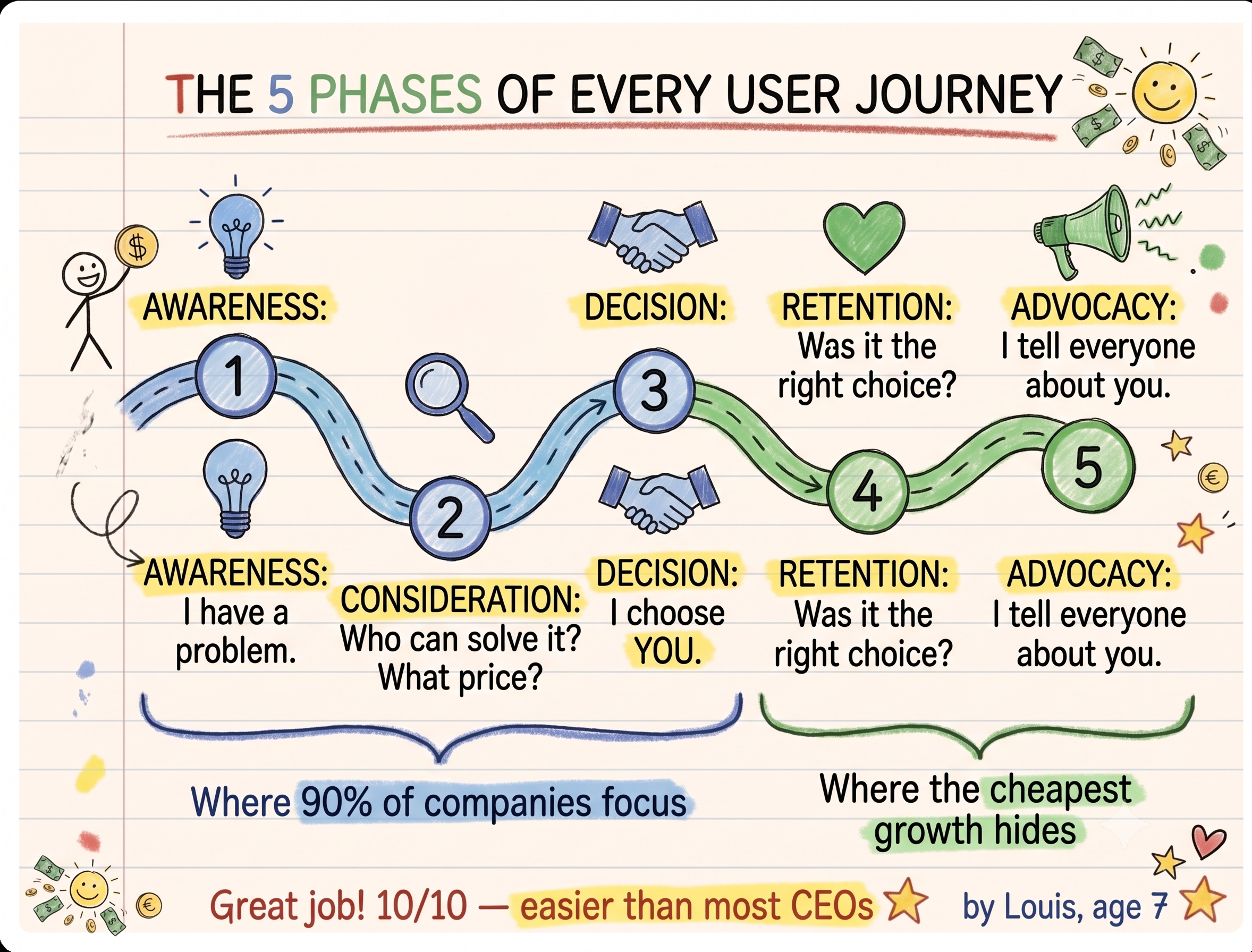
Here’s the direct link back to the money: retention and advocacy are LTV levers. Remember the LTV formula $1,500 × 6 months. If better service and follow-up push average retention from 6 to 9 months, your LTV jumps from $9,000 to $13,500.
Your CAC ceiling rises from $2,700 to $4,050. Suddenly channels that were “too expensive” become profitable, and you can outspend every competitor on acquisition. The company that can afford the highest CAC wins the market and that’s an LTV game, not an ads game.
Map YOUR journey (the method)
Take a spreadsheet with 5 columns, one per phase. For each phase, answer 4 questions: what is the prospect thinking / feeling (state of mind)? What are they trying to find out (their questions)? Where are they (possible touchpoints)? What is THE single next action we want (one goal per phase)?
The full exercise for our cleaning company: during the acquisition phases, here’s what’s happening in the prospect’s head. At Awareness, they think “the offices make a bad impression” they’re not looking for anything yet, or at most typing “office cleaning [city]” into Google, and they’ll encounter you through Google, LinkedIn or word of mouth. The one action you want: a click to your site.
At Consideration, the question becomes “who’s reliable, and how much?” they hunt for prices, reviews and comparisons across your website, your Google reviews and your quote. The one action you want: a quote request. At Decision, it’s “which one do I pick?” they’re looking for proof, guarantees and responsiveness during the sales meeting and in your proposal. The one action you want: a signature.
Then come the loyalty phases, where most companies go silent. At Retention, the client wonders “did I choose right?” what they need is consistent quality and a real contact person, and the touchpoints are the service itself, your follow-up and your reporting. The one action you want: a renewal. At Advocacy, they think “I’m happy I can say so,” and what they’re missing is simply a reason to talk about you. A well-timed email or check-in call is the touchpoint, and the one action you want: a referral or a Google review.
Once the table is filled, your action plan reveals itself: every empty or weak cell = a project.
Assign each channel to its phase
This is where Part 2 and Part 3 connect. No channel is good at everything each channel excels at ONE phase: Awareness → LinkedIn content, SEO articles (“how to keep offices clean”), display, first-touch cold email. Consideration → comparison SEO (“office cleaning prices 2026”), retargeting, case studies, reviews, newsletter.
Decision → Google Ads on transactional keywords (“office cleaning quote”), quote follow-up sequence, sales call, guarantee. Retention → structured onboarding, monthly reporting, quarterly review, satisfaction survey. Advocacy → referral program, automated review request at day 30, co-signed case study.
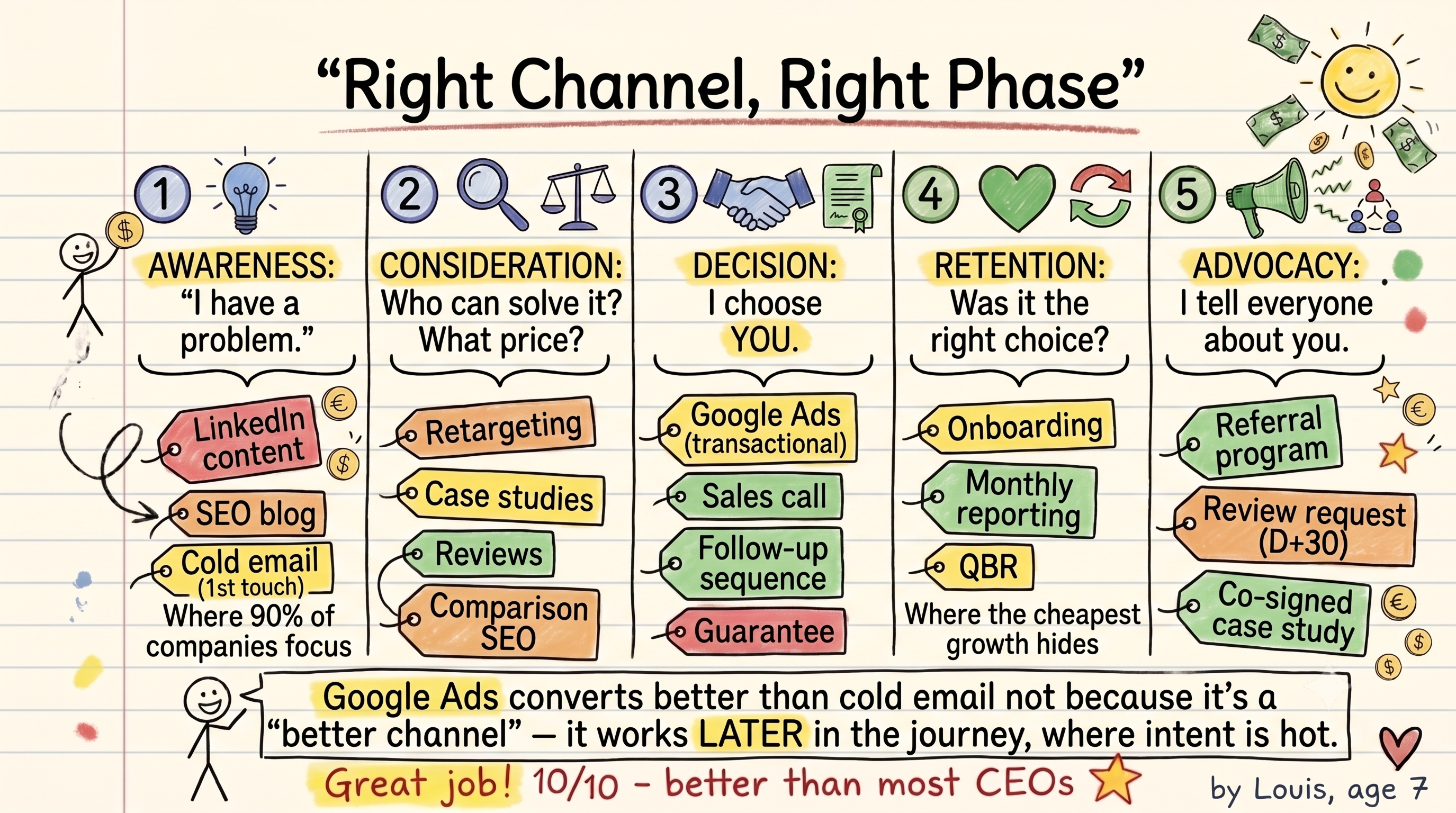
And this explains the CAC numbers from Part 2: Google Ads converts well because it operates at the Decision phase. Cold email closes at a lower rate because it reaches people at Awareness. The channel isn’t “worse” it works earlier in the journey, so the path is longer. Measure it with that reality in mind.
Plug the leaks (funnel math)
Your journey is plumbing. At every phase transition, you lose people. The game: measure where it leaks, plug the biggest leak first.
Real numbers: 1,000 website visitors → 30 quote requests (3%) → 15 meetings attended (50%) → 3 clients signed (20%). Three possible levers: Lever A, raise site conversion from 3% to 5% → 5 clients instead of 3 (+66%) zero extra ad spend. Lever B, raise show-up rate from 50% to 70% (day-before reminder + SMS) → +40% clients. Lever C, raise ad budget by 66% → +66% clients, but you pay full price for it.
Levers A and B improve the journey. Lever C pays to compensate for a leaky one.
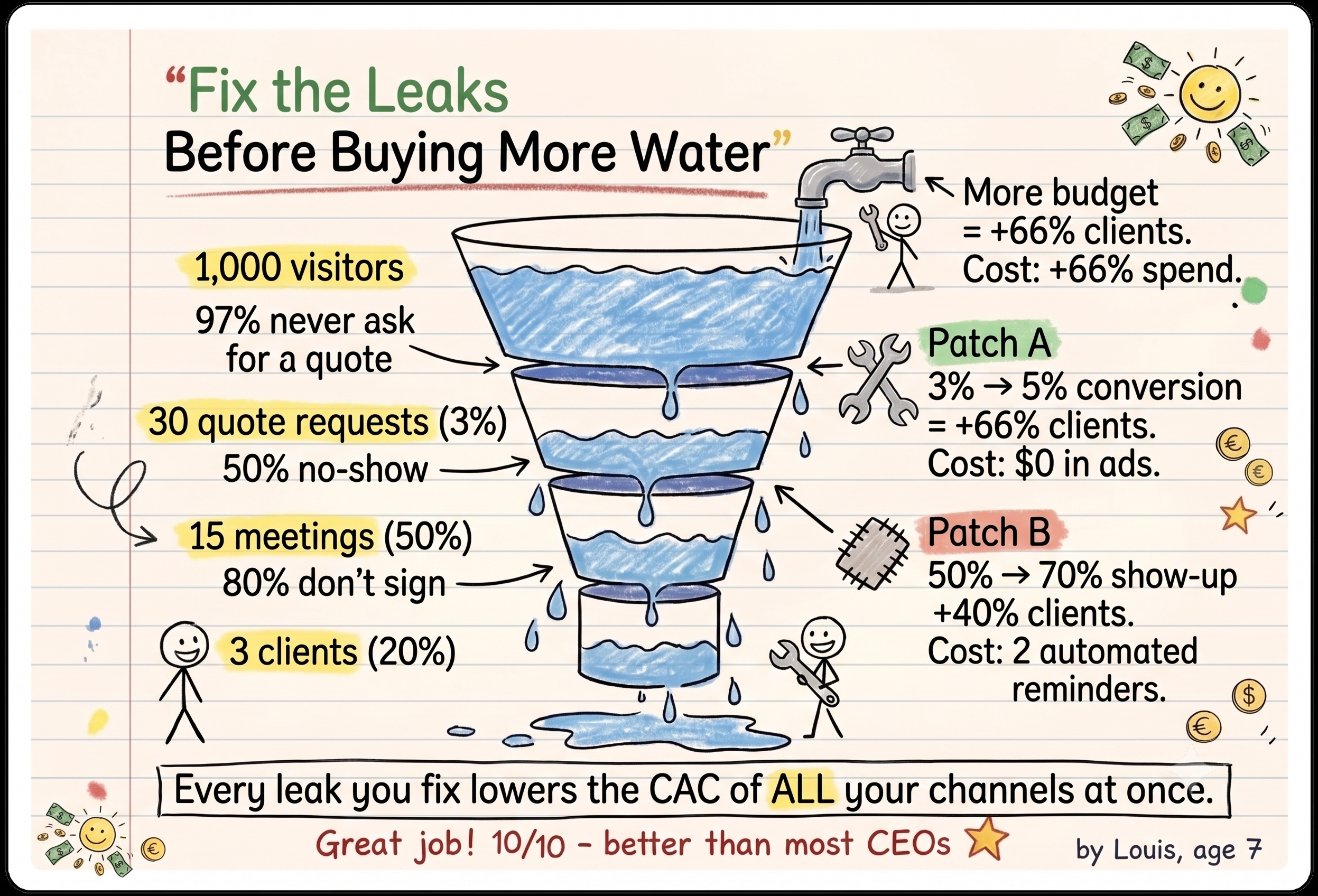
Always optimize the journey before raising the budget every conversion point you gain lowers the CAC of ALL your channels simultaneously. Which raises your margin. Which lets you outspend competitors. See how everything loops back to the inequality?
The diagnostic tree: which leak first?
You’ve measured your funnel. Several numbers look weak. Which one do you attack first? Follow this order it’s ranked by effort-to-impact ratio.
1. Speed to lead. If leads wait more than 15 minutes for a first contact, fix nothing else before this. It costs zero and the impact is brutal: contact within 5 minutes vs. 24 hours can multiply conversion several times over. One automation, one afternoon of setup.
2. Show-up rate below 60%. Day-before reminder + 1-hour SMS. Also nearly free, recovers 15–20 points.
3. Landing page conversion below 2%. Before rebuilding the page, check the basics: does the headline match the ad? Is there ONE clear action? Does it load in under 3 seconds on mobile? Is there a phone number? These four fixes usually double a weak page.
4. Lead → meeting below 30%. Usually a qualification or follow-up problem, not a lead quality problem. Check: are leads followed up at day 2 and day 5? Is someone actually calling them?
5. Meeting → client below 10%. Now it’s a sales problem offer, proof, pricing, or the wrong prospects entirely. This one is the hardest to fix, which is exactly why you fix the other four first: they’re cheaper and faster.
Only after all five: raise the budget. Buying more traffic into a leaky funnel is the most expensive way to grow that exists.
The 3 minimum automations
You don’t need a $50,000 CRM. Three automations cover 80% of the value.
1. Lead follow-up (Consideration → Decision). A lead contacted within 5 minutes converts massively better than one contacted the next day. Minimum setup: instant confirmation email + team notification + follow-ups at day 2 and day 5. Most quotes are lost through simple absence of follow-up.
2. Meeting confirmation. Automatic reminder 24h before + 1h before. It’s dumb and it recovers 15 to 20 points of show-up rate.
3. Review / referral request (Advocacy). Automatic email at day 30: “Happy so far? A Google review helps us enormously.” At day 90: a referral offer. Every referred client has a near-zero CAC and mechanically pulls your blended CAC down.
Should you build this in-house or outsource it?
Everything in this guide can be done internally. The question is whether it should be. The honest breakdown:
Build in-house when: acquisition is your core competitive advantage, you have (or can hire) someone who’s done it before, and you have 6–12 months of runway to let them learn your market. Cost: a competent growth profile runs $60–100k/year, plus tools, plus the 3–6 months before they’re productive.
Outsource when: you need results inside a quarter, acquisition is a means and not your craft, or your volume doesn’t justify a full-time hire. An agency or freelancer has already made the expensive mistakes on someone else’s budget. Cost: typically a setup fee plus a monthly retainer which should be judged like any channel: their fee is part of your CAC. If the agency costs $2,000/month and delivers 4 clients, that’s $500 of CAC per client from fees alone, before ad spend. Below your ceiling? Good deal. Above? Same rule as LinkedIn Ads in Part 2: cut it.
The hybrid most SMBs land on: outsource the setup and the specialized layers (campaign structure, tracking, sequences), keep the sales conversations in-house. Nobody sells your product better than you but nobody should learn Google Ads on your budget either.
The test that settles it: calculate the CAC of each option, including all salaries and fees, fully loaded. The math doesn’t care about your preferences.
The synthesis: the complete system in 10 steps
The one checklist to keep:
1. Calculate your LTV (average revenue × customer lifespan). 2. Set your max CAC (10–30% of LTV). 2b. Calculate your payback period (CAC ÷ monthly revenue per client). Under 6 months = scale. Over 12 = fix your cash model first. 3. Turn your revenue goal into a budget (goal ÷ LTV = clients needed × CAC = budget). 4. Capture existing demand first (Google Search, SEO, local) before creating demand.
5. Measure one CAC per channel, never a blended one. Cut above the ceiling, double down below. 5b. Load your CAC fully: salaries, tools, commissions not just ad spend. 6. Split 70/20/10 (proven / promising / experimental) or ONE channel if starting from zero. 7. Map your journey in 5 phases and assign each channel to its phase. 8. Plug the leaks before raising the budget: site conversion, lead follow-up, show-up rate, reviews and referrals.
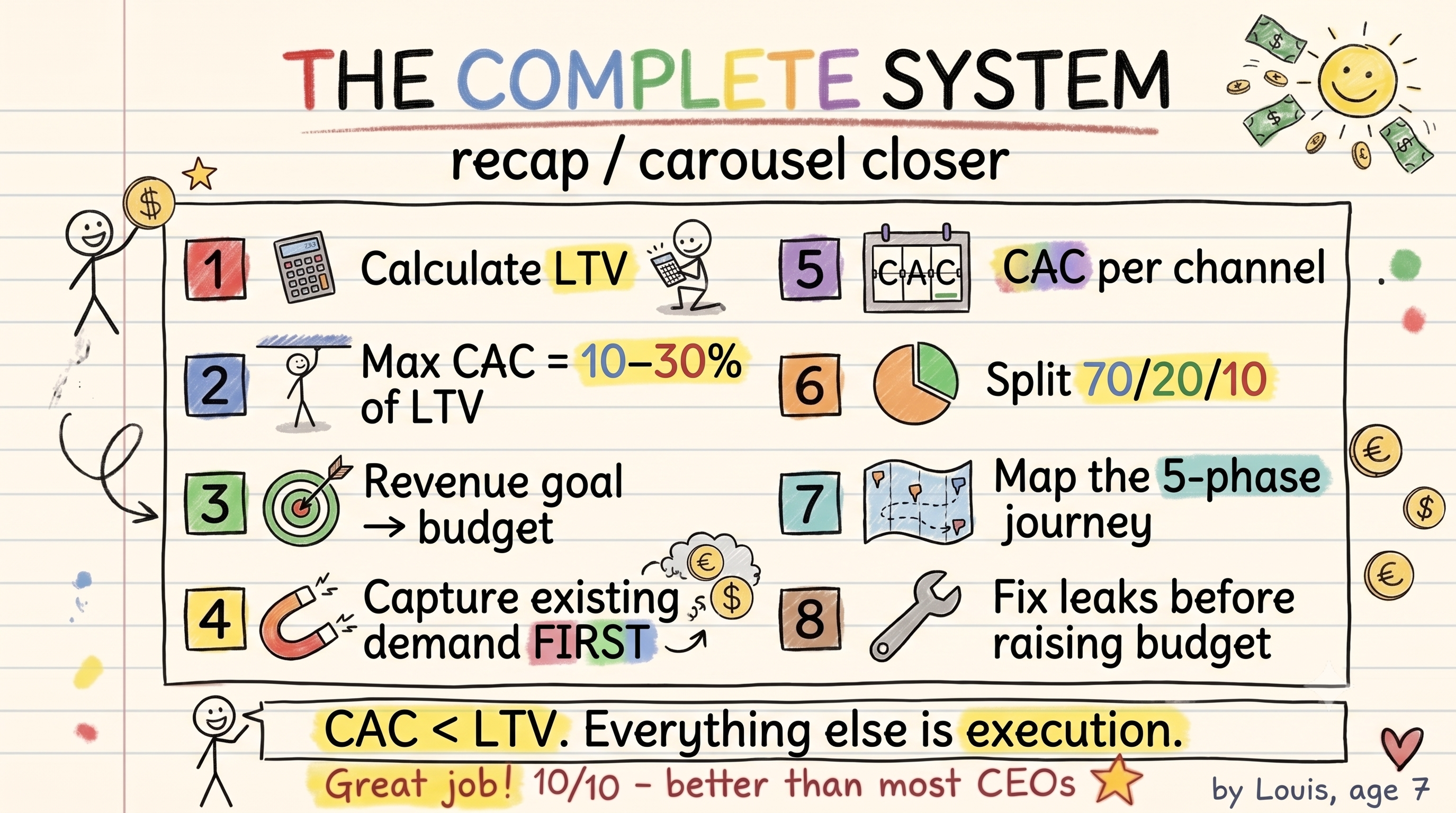
And we’re back exactly where we started: want $10,000? Spend $1,000–4,000. Want $100,000? Spend $10,000–40,000. Want $1,000,000? Spend $100,000–400,000.
The problem was never “ads are expensive.” The problem was not knowing your numbers. Now you know them. Now you know where to put the money. Now you know what happens after the click.
That’s not marketing anymore. That’s revenue engineering.
Key takeaways
That’s not marketing anymore. That’s revenue engineering.
Leads are not weather. They’re math. The full system to turn a revenue goal into a budget, split that budget across channels, and fix the user journey so nothing leaks along the way.
FAQ
What’s a good CAC for a B2B service business?
There’s no universal number only a universal ratio. Your CAC should sit between 10% and 30% of your LTV. A $3,000 CAC is excellent against a $30,000 LTV and fatal against a $6,000 one. Calculate your LTV first; your CAC ceiling falls out of it.
How much should I spend on lead generation per month?
Work backwards from revenue: revenue goal ÷ LTV = clients needed; clients needed × target CAC = budget. A company targeting $30,000 in new contracts with a $9,000 LTV and a $2,000 CAC needs roughly $6,000–8,000. Never start from “what feels affordable” start from the goal.
How long before lead generation becomes predictable?
Expect 60–90 days per channel to get a stable CAC: enough volume for the numbers to mean something, plus one or two iteration cycles. This is why you launch ONE channel at a time when starting three channels at once triples the time to statistical clarity.
Is cold email still effective in 2026?
Yes, if three conditions hold: clean, verified data (bounce rate under 3%), warmed-up sending infrastructure with volume limits, and multi-step sequences (half of replies come from follow-ups). Cold email “stopped working” only for people who skip one of the three.
Should I do SEO or paid ads first?
Both are demand capture, so both come before demand generation but they run on different clocks. Paid search delivers leads in weeks and stops the day you stop paying; SEO takes 6–12 months and compounds. Standard play: launch Google Ads now for immediate flow, build SEO in parallel so it progressively replaces the paid volume.
What’s the difference between a lead and a qualified lead?
A lead is a contact. A qualified lead matches your ICP (right size, right industry, right problem) and has shown intent (requested a quote, booked a call). Measure your CAC on signed clients, not on leads 500 unqualified leads are worth less than 20 qualified ones, and lead-count vanity metrics are how agencies hide bad performance.